

How Do I Speed Up My Css Animation
CSS must pass through a relatively complex pipeline, merely like HTML and JavaScript. The browser must download the files from the server and then proceed to parsing and applying them to the DOM. Due to farthermost levels of optimisation, this process is usually pretty fast – for smaller web projects not based on frameworks, CSS ordinarily makes up just a small part of full resource consumption.
Frameworks upset this equilibrium. Include a JavaScript GUI stack like jQuery UI, and picket CSS, JS and HTML sizes skyrocket. Often, developers usually feel the pinch last – when seated behind a powerful eight-core workstation with T3 internet, no one cares about speed. This changes as latencies or CPU-constrained devices come up to play.
- 19 absurd CSS animation examples to recreate (opens in new tab)
Optimising CSS requires a multi-dimensional approach. While hand-written lawmaking can exist slimmed down using various techniques, going over framework code by hand is inefficient. In these cases, using an automated minimiser yields improve results.
The following steps will have us on a journey through the globe of CSS optimisation. Not every single ane might exist directly applicable to your project, but practice proceed them in listen. Want something simpler? Try a website builder.
01. Use shorthand

The fastest CSS clause is one that never gets parsed. Using shorthand clauses, such as the margin declaration shown below, radically reduces the size of your CSS files. A lot of additional shorthand forms tin be institute by googling 'CSS Shorthand'.
p { margin-superlative: 1px; margin-right: 2px; margin-lesser: 3px; margin-left: 4px; } p { margin: 1px 2px 3px 4px; } 02. Find and remove unused CSS
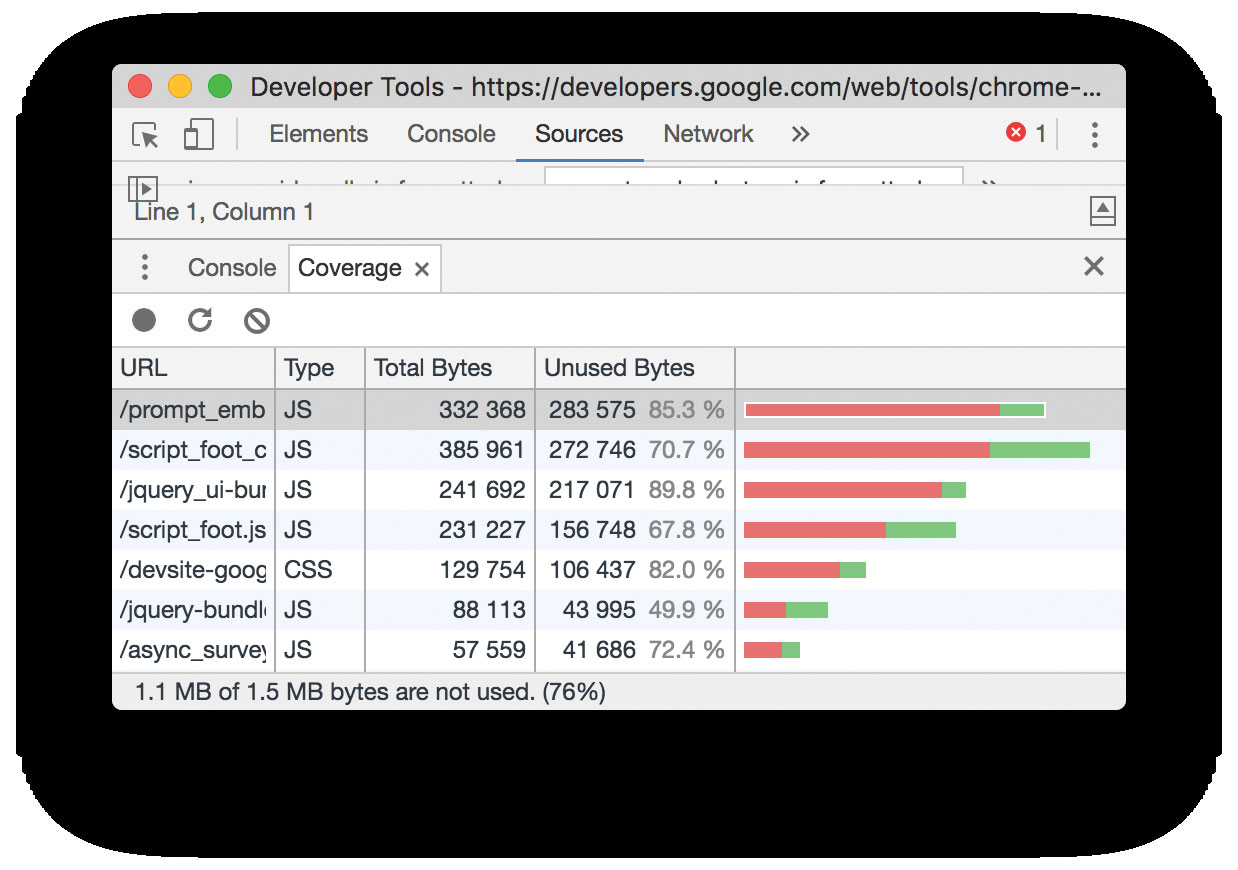
Eliminating unneeded parts of your mark-up manifestly causes immense speed gains. Google's Chrome browser has this functionality out of the box. Simply go to View > Developer > Programmer Tools and open up the Sources tab in a recent version, and open the Command Menu. After that, select Testify Coverage and feast your eyes on the coverage assay window highlighting unused code on the current webpage.
03. Do it in a more comfortable fashion
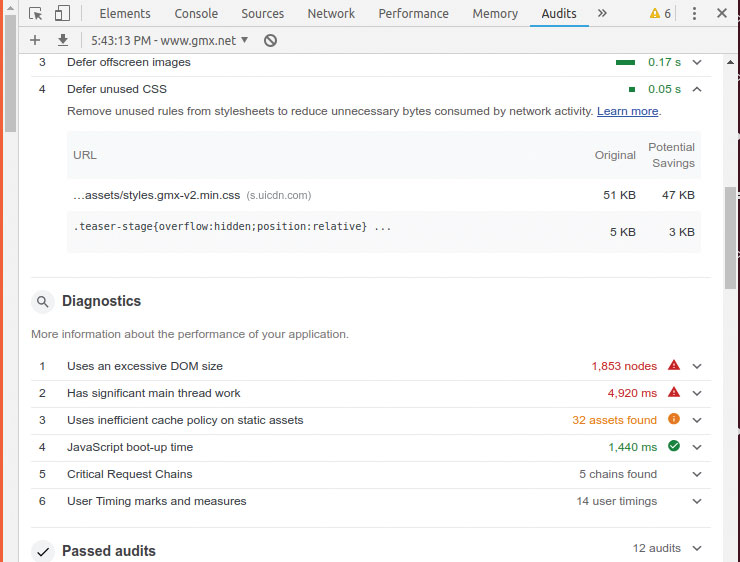
Navigating through the line-by-line analysis is not necessarily comfortable. Chrome'southward Web Performance Inspect returns similar information – simply open it from the toolbar, View > Programmer > Developer Tools > Audits and let information technology run. When done, a list of problematic elements will pop up.
04. Be enlightened of the problems
Keep in mind that an automatised analysis of a CSS tin e'er pb to errors. Perform a thorough exam of the entire website after replacing your CSS files with the minified ones – one never knows what mistakes the optimiser acquired. And moving forward, decent web hosting can assist yous iron out the creases in your site.
05. Inline disquisitional CSS
Loading external stylesheets costs time due to latency – anyone remember the 'flash of unstyled content'? The virtually disquisitional bits of code tin therefore get into the header tag. Make sure not to overdo it, however. Go along in listen that the code must besides be read by humans performing maintenance tasks.
<html> <head> <style> .blue{color:bluish;} </style> </head> <torso> <div class="blue"> Hello, globe! </div> 06. Let antiparallel parsing
@import adds structure to your CSS code. Sadly, the benefits are not for costless: equally imports tin can nest, parsing them in parallel is non possible. A more parallelisable manner uses a series of <link> tags, which the browser can fetch at one time.
@import url("a.css"); @import url("b.css"); @import url("c.css"); v<link rel="stylesheet" href="a.css"> <link rel="stylesheet" href="b.css"> <link rel="stylesheet" href="c.css"> 07. Supercede images with CSS
Years ago, a prepare of semi-transparent PNGs to create translucent effects on websites was commonplace. Present, CSS filters provide a resource-saving alternative. As an example, the snippet accompanying this step ensures that the flick in question appears every bit a grayscale version of itself.
img { -webkit-filter: grayscale(100%); /* onetime safari */ filter: grayscale(100%); } 08. Use colour shortcuts
Common wisdom teaches that vi-digit colour descriptors are the most efficient way to express colours. This is non the example – in some cases, shorthand descriptions or colour names can exist shorter.
target { background-color: #ffffff; } target { background: #fff; } 09. Eliminate unneeded zeros and units
CSS supports a broad variety of units and number formats. They are a thankful target for optimisation – both trailing and following zeros can be removed, as is demonstrated in the snippet beneath. Furthermore, go along in mind that a zero always is a goose egg, and that adding a dimension does not add value to the data contained.
padding: 0.2em; margin: 20.0em; avalue: 0px; padding: .2em; margin: 20em; avalue: 0; 10. Eliminate excessive semicolons
This optimisation is somewhat disquisitional, as information technology affects changes of lawmaking. CSS' specification lets yous omit the last semicolon in a holding group. Equally the savings accomplished by this optimisation method are minimal, we mention this mainly for those who are working on an automated optimiser.
p { . . . font-size: one.33em } 11. Use a texture atlas
Loading multiple small sprites is inefficient due to protocol overheads. CSS sprites combine a series of pocket-sized pictures into one big PNG file, which is then broken apart via CSS rules. Programs such equally TexturePacker (opens in new tab) simplify the cosmos process profoundly.
.download { width:80px; height:31px; background-position: -160px -160px } .download:hover { width:80px; height:32px; background-position: -80px -160px } 12. Chase downwards the px
One neat way to increase performance uses a specialty of the CSS standard. Numeric values without a unit of measurement are assumed to be pixels – removing the px saves two bytes for each number.
h2 {padding:0px; margin:0px;} h2 {padding:0; margin:0} 13. Avoid expensive backdrop
Assay has shown some tags to exist more expensive than others. The listing accompanying this pace is considered to be specially performance-hungry – avert them when given the opportunity to exercise so.
edge-radius box-shadow transform filter :nth-child position: fixed; etc. 14. Remove whitespace
Whitespace – recall tabs, carriage returns and spaces – makes code easier to read but serves trivial purpose from a parser's point of view. Eliminate them before shipping. An even better way involves delegating this job to a shell script or similar apparatus.
Comments as well serve no purpose to the compiler. Create a custom parser to remove them before delivery. Not simply does that salve bandwidth but information technology also ensures that attackers and cloners accept a harder time understanding the thinking behind the code at paw.
16. Use automatic pinch
Yahoo's user experience team created an awarding that handles many compression tasks. It ships equally a JAR file, available here (opens in new tab), and tin can be run with a JVM of selection.
java -jar yuicompressor-x.y.z.jar Usage: java -jar yuicompressor-x.y.z.jar [options] [input file] Global Options -h, --help Displays this information --type <js|css> Specifies the blazon of the input file 17. Run it from NPM
Should you lot prefer to integrate the product into Node.JS, visit npmjs.com/parcel/yuicompressor (opens in new tab). The desperately maintained repository contains a set of wrapper files and a JavaScript API.
var compressor = crave('yuicompressor'); compressor.compress('/path/to/ file or String of JS', { //Compressor Options: charset: 'utf8', type: 'js', 18. Keep Sass et al in check
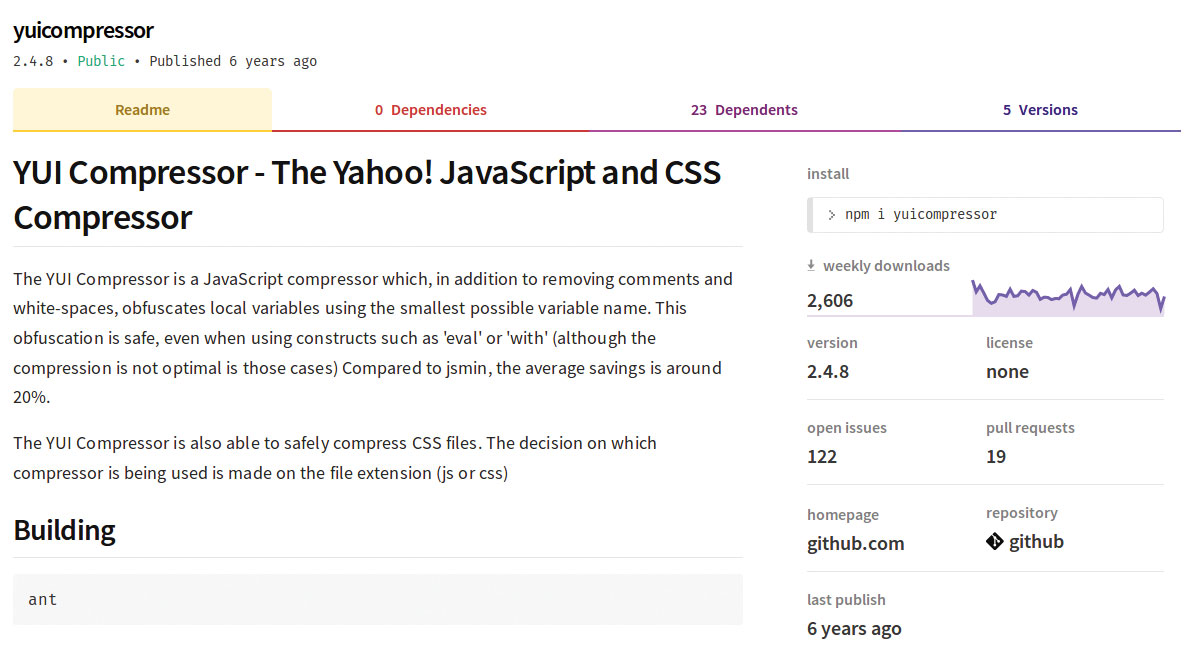
While CSS selector operation is not nearly as disquisitional as it was some years agone (see resource), frameworks such as Sass sometimes emit extremely complex lawmaking. Take a expect at the output files from fourth dimension to fourth dimension and think well-nigh ways to optimise the results. Got results to share with a team? Keep files in shareable cloud storage.
- What is Sass? (opens in new tab)
19. Set up caching
An old adage claims that the fastest file is i that never gets sent across the wires. Making the browser cache requests achieves this efficiently. Sadly, the setup of the caching headers must take place on the server. Make expert use of the ii tools shown in the screenshots – they provide a swift way to analyse the results of your changes.
20. Bust the cache
Designers often dislike caching due to fear of problems with upcoming changes. A neat style around the problem involves including tags with the file name. Sadly, the scheme outlined in the code accompanying this pace does non work everywhere as some proxies refuse to enshroud files with 'dynamic' paths.
<link rel="stylesheet" href="style.css?v=1.2.3"> 21. Don't forget the basics
Optimising CSS is merely function of the game. If your server does not utilise HTTP/2 and gzip compression, a lot of time is lost during data transmission. Fortunately, fixing these 2 problems is usually unproblematic. Our example shows a few tweaks to the commonly used Apache server. Should you discover yourself on a dissimilar system, but consult the server documentation.
pico /etc/httpd/conf/httpd.conf AddOutputFilterByType DEFLATE text/html AddOutputFilterByType Deflate text/css This article was originally published in issue 282 of artistic web design mag Spider web Designer (opens in new tab) . Buy outcome 282 here (opens in new tab) or subscribe to Web Designer hither (opens in new tab) .
Related manufactures:
- 10 amazing new CSS techniques (opens in new tab)
- Which is the all-time CSS preprocessor? (opens in new tab)
- An introduction to CSS custom properties (opens in new tab)
Source: https://www.creativebloq.com/how-to/21-ways-to-optimise-your-css-and-speed-up-your-site
Posted by: harnishfaillims90.blogspot.com
0 Response to "How Do I Speed Up My Css Animation"
Post a Comment