

What Are The Differences Between Frame-by-frame Animation, Motion Tweening, And Shape Tweening?

In this lesson, you can expect to:
 Explore Flash as a time-based medium.
Larn to manipulate the timeline and its frames.
Acquire basic approaches to movement tweening, shape tweening, and frame animation.
Learn tips for fugitive sloppy shape tweens.
| |
| A frame is an individual unit or sequence in an blitheness. A keyframe is a special kind of frame: Information technology initiates a change or adds a new element to the blitheness. |

 | |
| Animation Overview |
Before we become on with animation, showtime, some more attending needs to be paid to the Timeline, and so allow'southward go for it. Open a new Flash document, and gear up information technology upwardly according to our standard specs (ActionScript 2.0, 800x600, 24 fps).
Starting out, y'all've got a single frame and a single layer. With a single frame, your Flash movie will get nowhere, then the first pace is to add frames to Layer 1. To do this:
Click on the first frame in the Timeline and then hit F5 to add a frame. (You could select Insert > Timeline > Frame, simply that is unbelievably tedious; the cardinal commands are much faster, and then get used to using them to edit frames on the Timeline.)
Yous'll ordinarily want to add many frames to the Timeline, so add about 10-fifteen frames (hit F5 about x-15 times). Do that, and your Timeline should look something like this:

fifteen frames on Layer one of the Timeline.
Frames vs. Keyframes
Taking a look at the graphic above, you'll see a circle in the showtime frame, nothing in the middle frames, and a rectangle in the concluding frame. The circle in the commencement frame indicates that this is a special kind of frame, called a keyframe.
A keyframe unremarkably means that something is going to alter in this frame. Since we're starting with cypher, Flash always automatically adds a keyframe to the offset frame.
You can only place content in keyframes. To test this out, click on any frame (other than frame 1) and draw a shape. You'll see that Flash automatically moves information technology into the blank keyframe! Click on frame 1 and you'll see it's there.
This is the difference between a keyframe and a regular frame. So what are regular frames used for? For one thing, frames keep the keyframe's content visible onstage and unchanged until a new keyframe is added to change the content!
See this for yourself: First, examination your film by hitting Ctrl/Command+Enter and you'll come across your shape is constantly visible. You can also see this on the Timeline; all of the frames have turned gray, and then content is on all of them.
Now, go back to the Timeline and click on a frame towards the end of the frames yous've added, then striking F7, which is the primal command for Insert > Timeline > Bare Keyframe. Calculation a blank keyframe removes the content from the keyframe (and subsequent regular frames), starting in this new keyframe.
Examination your movie (Ctrl/Command+Enter) and y'all'll run into a blinking blitheness. Here's what'southward happening: The Timeline is playing left to right, and showing the graphic from the first keyframe until it hits the second (blank) keyframe, which then shows a bare screen.
Once the Timeline gets to the end of all the frames added to the film, information technology will automatically loop and go back and first playing from frame 1, where the original keyframe and graphic are, and incessantly repeat itself.
Key Commands
Here are some more key control shortcuts for you lot to learn and utilize. You may desire to create a split up text file and copy and paste all of the usually used Flash central commands into information technology then that you take a main reference certificate that y'all can print out and refer to, until y'all take the shortcuts memorized.
| |
| Any animation where you prepare a starting and catastrophe frame then permit Flash do the remainder is called a tween. |
| |
| A classic tween is used for animations of motion, scale, effects, and so on. A shape tween is used for morphing shapes. |
| |
| Pressing Enter will play your movie, but exporting with Ctrl/Command |

| |
| Archetype tweens were called motility tweens in older versions of Flash. |

| |
| Motion tweens automatically generate keyframes when you move an object on a frame within the tween. |
| |
| Using easing volition make a motion tween less mechanical and more realistic. |
| |
| Ease In: Starts dull, then builds up speed. |
The about common way to breathing using Flash is called a tween, which is curt for "between," as in "between keyframes." If you've e'er created a GIF blitheness and used tweens and so, you'll have an understanding of this concept. A tween is a congenital-in Flash method for animating the difference between the content of two keyframes, in steps, across the frames in betwixt the keyframes... got that? No? Let'due south go hands-on, and then you can see how information technology works yourself...
Archetype Tweens
Let's start with the unmarried nigh popular tween, the classic tween. Older versions of Flash chosen this a "motion tween," simply as you'll see afterwards, CS4 and CS5's motility tween is a dissimilar animal.
The archetype tween is used only for animative film clips. And so, to make a classic tween in your exam FLA:
1. Select the shape you lot made in the first keyframe, and hit F8 to go far an MC (movie clip symbol).
2. Copy information technology (Ctrl/Command+C), click on the second, blank keyframe and paste (Ctrl/Command+5).
3. Drag this pasted MC anywhere on the Stage (somewhere different than where it is on the first frame).
4. The next step is to set the tween that volition move the MC across the Stage. The tween is going to animate the difference betwixt the kickoff keyframe and the second. So here, the blitheness will move the MC from its position in the first keyframe to its position in the second keyframe, in increments, beyond the number of frames in between the keyframes.
To add the tween, correct-click (Control-click on a Mac) on whatsoever frame in between the keyframes, and in the card that appears, choose Create Archetype Tween.
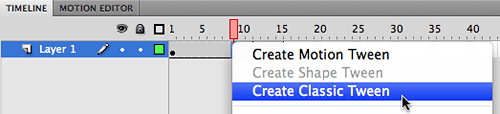
Creating a archetype tween
If you've washed this properly in either version of Flash, Wink volition draw an arrow on the frames in between the keyframes, similar this:
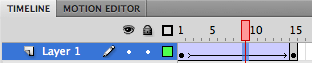
An arrow connects the keyframes and indicates a proper classic tween.
If you see the pointer on your Timeline, now is a great time to check out your blitheness. Offset, click and drag the red playhead along the frames of the Timeline to see your symbol as it moves across the screen. So, test your movie by pressing Ctrl/Command+Enter to see the animated SWF.
If your tween isn't set up properly, Flash will let you know that something is wrong past adding a dotted line to the Timeline, like this:
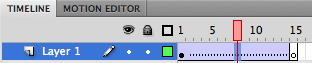
A dotted line indicates an problem.
Hither are some common causes of bad tweens:


Trying to classic tween annihilation other than a moving-picture show clip (such as shapes or groups).
Trying to classic tween 2 different MCs (a classic tween is always done with 2 instances of the aforementioned MC).
Trying to tween more than than one element on a layer.


Insert Keyframe vs. Insert Blank Keyframe
In the first tween example, you manually pasted the MC into the bare keyframe yous created before. Instead of making the 2nd keyframe a blank keyframe, you could have chosen Insert Keyframe (F6), which makes a new keyframe, then automatically copies the contents of the most contempo keyframe, substantially doing a copy and paste-in-place of the kickoff MC.
In that location will be times when you'll desire to use Insert > Timeline > Keyframe in order to maintain position or to brand animation easier. Other times, you volition use a blank keyframe; the difference betwixt the two is only efficiency, and that'south something you'll learn from experience.
Notation that you tin can besides insert a keyframe on any frame inside a classic tween to make a change in the middle of your animation. Retrieve that changes occur only on keyframes.
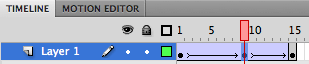
Here I've split our xv-frame tween with a newly inserted keyframe. Now I can brand a alter to the object on this frame.
Learning to tween can exist a claiming. Check out this video tutorial to come across some classic tweens in action. You lot'll notice that this video refers to classic tweens as "motion tweens" because it was created with a previous version of Flash. You tin easily translate this to the electric current CS4/CS5 archetype tween as the Timeline aspects y'all should expect at are exactly the same.
Running Time: 3:20 Read the TranscriptMotion Tweens
You only learned the "original" way to create a motion tween, called a classic tween. Earlier version CS4, this was the only way to make a motion tween. This method has its benefits and you may observe yous utilise it often, even though Wink CS4 and CS5 have a dissimilar style to make a move tween.
New motion tweens automate some of the keyframing to make animating a quicker process. Allow's try out this method. To showtime, open up a new Flash certificate so your previous classic tween doesn't get in the style.
one. On Layer 1, frame 1, depict a shape of your choice. Discover that, every bit ever, this frame becomes a keyframe.
2. Add 10-15 more (regular) frames to your picture past pressing F5 repeatedly or by going to Insert > Timeline > Frame. All of these frames will be gray, keeping your shape in identify on each ane.
iii. Click on your first frame, select your object, and convert it into a movie prune symbol.
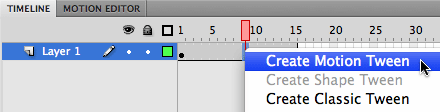
4. Right-click (Command-click on a Mac) on any frame in the Timeline and choose Create Motility Tween.
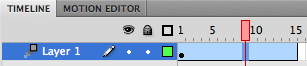
Notice that the frames volition now turn blueish, indicating a motion tween. They will not take the arrow you saw in the classic tween.
5. Now you need to tell the shape where to move. Click on the last bluish frame in your Timeline, so select the shape and motility it somewhere else on the Stage.
Yous'll come across the path of motion indicated by a greenish line, and if you move your red playhead forth the frames, yous'll run into it travel along.

Notice that a diamond shape is placed on the terminal frame. This indicates an automatically generated keyframe. Your tween is done!
But let's say you'd like to brand the shape change path midway along the frames, say on frame 8. Click on frame 8 and move your shape. Notice how the path changes, a new automated keyframe is generated, and your shape animates on the new path. This would take taken longer with a archetype tween because you'd have to create a new keyframe in the eye.

You can move your object around on any frame in the movement tween to alter the animation. Keyframes will generate automatically.
Classic and motion tweens are the about pop animation methods in Flash because of their flexibility. I'll walk you through some of the possibilities. Notation that all of the features beneath are available for both classic and motion tweens.
Number of Frames = Speed
The corporeality of time your tween takes is directly related to how many frames are between the keyframes (and, of course, to the movie's frame charge per unit). Experiment with your animation past adding frames: Click on a frame in the classic tween you lot created earlier and hit F5 one or more times. Or yous can subtract frames to shorten the time (click and press Shift+F5 to subtract a frame from a classic tween).
In your motion tween, you lot tin add frames by stretching the concluding blueish frame in the Timeline.

Click and drag the finish of the blue frames in the Timeline to add frames to a motion tween.
Animating Other Properties
Remember that tweens animate the difference in backdrop betwixt the keyframes. This applies to any difference, non just location. Select the MC in the second keyframe of a tween you've created (either classic or motion), and use the Complimentary Transform tool to scale it upwardly and brand information technology bigger. Then test your movie (Ctrl/Control+Enter) to spotter it grow as it tweens. Cool, huh? You lot could even use Free Transform to rotate it.
Ane of the most unproblematic yet effective Wink animation techniques is the fade. By changing a movie prune's alpha property, you tin can fade it in or out onstage for a very dramatic yet swish effect. (Can you tell that I similar alpha fades?)
Achieving a fade in Flash is like shooting fish in a barrel: Select an MC on either one of the keyframes of your classic or motion tween, then use the Backdrop panel to change its Blastoff holding. Remember, this is found in the Color Upshot carte in the Properties panel.
Bring the alpha down to 0% and so the shape disappears on your keyframe.
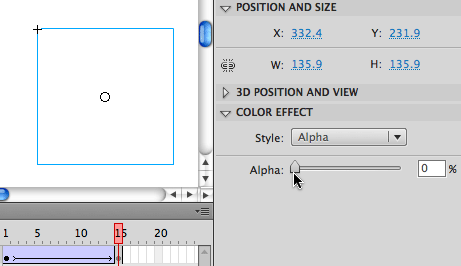
Reducing the Blastoff value in the second keyframe volition cause the tween to "fade out" the MC.
Test your motion picture, and you'll run across the MC fading in or out, depending on which keyframe you inverse!
Easing
You'll notation that currently, your animations happen at the aforementioned charge per unit across time. There is no acceleration or deceleration. This is often fine only can exist boring. To add some multifariousness to your tweens, yous can turn on the easing option which will cause the tween to accelerate or decelerate, either starting boring and and then speeding upwards or starting fast and slowing downwards at the stop. This creates a more realistic upshot (in real life, objects rarely move at the same speed throughout a movement—remember about a car coming to a finish sign).
Below you'll meet ii animated text samples, the starting time with easing and the second without.

In the top animation above, yous tin can see easing used to accelerate the type when you click play. In the bottom example, easing is not used. To set the easing on a tween, select a tweened frame on the Timeline, and and so use the Ease slider on the Backdrop panel. Annotation that the Ease slider is in a different identify depending on the type of tween. For a classic tween, you lot'll find information technology under the Tweening menu in the Properties panel. For a motion tween, you'll find it under the Ease bill of fare in the Properties panel. More than advanced easing is also available for motility tweening in the Motility Editor panel, but for this course, let'south stick to the nuts.
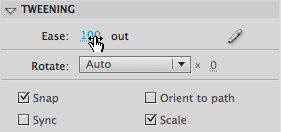
Adjusting the Ease slider in a classic tween
The basic easing parameters are as follows:
Ease in: Starts tiresome, then builds upwardly speed.
Ease out: Starts fast, then slows downwardly.
Since this is a subtle effect, I recommend that you crank information technology all the way upward or downwards to really see it!
Below, spotter circles set with no ease, loftier ease, and low ease and compare how they travel.
Each circle in the blitheness above starts at the same point, but is and so dictated by a dissimilar easing setting. The result is subtle but noticeable.
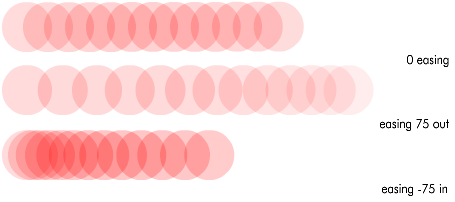
Here is the same ruby-red circle blitheness, but with onion skinning turned on (we'll look at how to utilise onion skinning later). You can see where the brawl is moving speedily or slowly. Where the circle is clustered closely is a slower rate of animation speed, and where information technology is spread further autonomously is a faster rate of speed.
When Flash was offset introduced, shape tweening was one of its virtually unique features. While classic and motion tweens are used exclusively on symbols, shape tweens are exclusively used on shapes. Used properly, shape tweens can create visually interesting nonlinear blitheness effects. Unfortunately, they are often unpredictable and hard to piece of work with, then again, let's offset with a very simple instance...
We volition use the same file with the animated movie prune you lot already created for the classic tween. Add some other layer and we'll piece of work there. Did you notice that your new layer has the aforementioned number of frames every bit the onetime one, but they're all blank?
Create an oval shape on the first keyframe of the new layer. Do not convert your new circle to a symbol! You can only shape tween with raw shapes, not groups or picture show clips. (This may sound limiting, but consider that you can create a shape tween with a raw shape inside a movie prune'south Timeline when you become some more tweening experience under your chugalug.)
The new layer does not have the second keyframe in the last frame, and then yous will need to add together it yourself. On the final frame, insert a keyframe (F6). With that keyframe selected, delete the oval and depict a square with a fill of a different color (only no stroke color) in approximately the aforementioned place as the circle sits. Once more, exercise not convert it into a symbol.
Then select a frame between the keyframes of the circle and square, and then add a shape tween. To do this, right-click (Control-click on a Mac) and cull Create Shape Tween.
Yous volition see that an arrow and a dark-green tint appear over the frames betwixt your shapes.
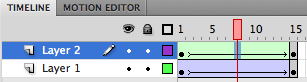
Test your moving picture to see the blitheness. If it'due south correct, the circle will morph into a foursquare, and slowly change colors. Crawly!
In the commencement blitheness beneath, a foursquare becomes a circle, the opposite of your experiment above. You'll likewise run into two other shape tweens. Discover in each the Blend setting used (which you lot tin modify in the Properties panel) as well every bit the easing.
Here are iii different examples of how shape tweening can exist used. Click play to activate each one.
| |
| Broken or fractured shapes are one symptom of sloppy shape tweens. |
| |
| Aim for a clean, easy to read motions in your animation. |
| |
| Take care to maintain a persistent land for objects that are not intended to move. |
| |
| Cel animation is more hard than tweening or morphing merely may be necessary for specific details in your movie. |
Avoiding Sloppy Shape Tweens
Shape tweens often look impressive to Flash newbies, but try to avert sloppy tweens. A sloppy shape tween may wait interesting at first, only trust me, they indicate lack of skill to those who know the concern. Look at this SWF file and discover the fractured and distinctly unclean morph:
Morphs with a fractured quality don't look professional.
Another problem with my case of shape tweening here is that the animation does not loop smoothly. With short forms of animation like this, it is e'er improve to have a smoothen loop than a difficult cut. Furthermore, the font has serifs (those little points on the ends). Shape tweens work best with very unproblematic shapes, so a font like Arial Black would exist a meliorate selection than Times New Roman.
This version eliminates the shattered shapes, loops the blitheness, and uses a simpler font:
Opening my file (shape2.fla in your downloads binder) and looking at the shapes in the frames will reveal how I avoided the spider webs in this shape tween. The oval is a solid shape until the tween begins. At that point I take a new keyframe wherein the oval has been cut into four pieces, one for each of the letters.
Ii holes take been cut in the first piece to allow for the "B" and one pigsty has been cut in the last piece for the "due east." The eye two pieces practise not demand holes because the letterforms they get practice non take enclosed areas.
The lesson hither? Trying to morph betwixt objects that will require going from one shape to several, or from a solid object to an object with holes cut in it, volition shatter shape tweens.
I of the most baffling things to new Wink users is how to use keyframes to keep an object persistent (unchanging) on the Phase. This will require some work on your office to modify our start classic tween example. Let'south have our MC on Layer one fade in, appear onstage for a while (be persistent), and so fade out.
To get-go, y'all will need to modify your archetype tween into a fade-in if it is non already. To exercise this, click on the MC in the showtime keyframe, change its Alpha to 0%, then click on the MC in the second keyframe and set its Alpha to 100%.
At present, since you want to proceed the MC visible onstage after information technology fades in, you need to add frames to its layer. To exercise this, click on the second keyframe and hit F5 (or Insert > Timeline > Frame) 10-15 times to add frames. Side by side, click on the concluding frame that'southward been added and hitting F6 (or Insert > Timeline > Keyframe), which will add a keyframe and copy the MC into the same position as in the last keyframe (run into, I told you this would come in handy).

At this point, you have a fade in of your MC on Layer 1, then a persistent state until the last frame.
Now, to add the fade-out, click on the 3rd keyframe (the ane you just added), and striking F5 to add about 5-7 frames. Then, click on the last frame that you but added, and hit F6 to add the quaternary and final keyframe.
Now, to complete your fade-out, select the MC in the last keyframe, and set its Alpha to 0. Then, to add together the tween to all the frames, click on the first keyframe, then hold downward the Shift key and click on the final keyframe, which volition select all of the frames.
Finally, correct-click (Control-click on a Mac) and choose Create Classic Tween.
Examination your animation—you should come across your MC fade in, remain in position for a while, and then fade out.
What y'all've done here is create three stages to your animation. The beginning is the fade in, the second is when the MC doesn't do anything except sit there, and the third is the fade out. What yous should remember is this: 2 identical keyframes will keep an MC persistent in its position onstage during that menstruation. Animation is all about move, only in that location are times when no movement is required!
The third and final type of motion graphic we'll explore with Flash is called frame animation, based on traditional cel animation in which a series of however images are created and replayed to create the illusion of movement.
To animate in this style you must create each frame of the animation "by hand," instead of letting Flash tween it for you. This was the technique used to draw the tower-climbing monster in the animated cityscape. It is simply animation without tweens.
In the cat animation below, private frames are used to create all of its distinctive facial motions.
Here is an example of frame blitheness, also referred to as cel animation.
Every frame with an object in a dissimilar position must exist a new keyframe. To make this easier and to run into where the objects were in the last keyframes, Flash provides options called Onion Peel and Onion Skin Outlines. These buttons are below the frames on the left of the Timeline:
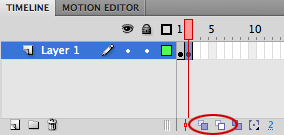
Onion Skin and Onion Skin Outlines options
You can use these options to run across faded frames before and after the frame you are currently drawing. Below is an instance of the option to the right of the onion skin button—onion skin outlines. The pink outlines are future frames, the white ones are past. The filled shape is the current frame.

Rex Kong shakes his hairy fist one frame at a time.
Frame blitheness can be used to create some very cool animations, just it does crave some skill and a lot of practice of traditional blitheness techniques.
It may or may non be surprising that these three basic animation techniques contain almost limitless possibilities for visual furnishings. Every bit you abound as a Wink animator, yous volition spend many hours tweaking variations and combinations of these techniques, and every bit y'all do so, y'all will larn to see subtle differences, and adjust accordingly!
To help you lot get started, I've included a tweens.fla file in your downloads containing the basic blitheness types that were shown in this lesson. Take a look at the file construction, and run into how each animation was constructed; feel free to brand changes to the keyframe content so you can see how information technology changes the animation!
Then, to recap, in this lesson, y'all've learned well-nigh the basics of how to animate in Flash, and the post-obit fundamental elements:
And the bones rules for creating tweens:
These are the basic mechanics of animative in Flash, merely within these seemingly unproblematic techniques lies the potential for creating a universe of animation effects! And, like a golf swing, lots of repetition is required to perfect them.
Learning the technical aspects of Flash blitheness is simply one-half of the battle. The other half is being able to use these techniques in a creative state of affairs. Onwards to Practice Iii, where you will do exactly that!


Practice
Create a smokin' banner advertizement (literally) incorporating some of the bells and whistles you've learned.Discussion
Which animation technique is easiest or most useful? Share your thoughts and opinions with other students at the Give-and-take Lath.
Source: https://documents.sessions.edu/eforms/courseware/coursedocuments/flashbasics_cs5/lesson3.html
Posted by: harnishfaillims90.blogspot.com
0 Response to "What Are The Differences Between Frame-by-frame Animation, Motion Tweening, And Shape Tweening?"
Post a Comment